Table of Contents
1. Introduction & Overview
This document analyzes the research paper "Optical Proof of Work" by Dubrovsky, Ball, and Penkovsky. The paper proposes a fundamental shift in the economic and hardware basis of cryptocurrency mining, moving from energy-intensive computation (OPEX-dominated) to capital-intensive, specialized photonic hardware (CAPEX-dominated). The core thesis is that while Proof-of-Work (PoW) must impose a verifiable economic cost, this cost need not be primarily electricity.
2. The Problem with Traditional PoW
Traditional SHA256-based PoW (Hashcash) has successfully secured networks like Bitcoin but faces critical limitations at scale.
2.1. Energy Consumption & Scalability
The primary cost of mining is electricity. As network value grows, so does energy consumption, leading to environmental concerns and creating a direct link between coin price, energy cost, and network security. Scaling Bitcoin 10-100x with current technology is seen as environmentally and economically unsustainable.
2.2. Centralization & Systemic Risk
Miners congregate in regions with the cheapest electricity (e.g., certain parts of China, historically). This creates geographic centralization, presenting single points of failure, vulnerability to regional regulation, and increased risk of partition attacks.
3. Optical Proof of Work (oPoW) Concept
oPoW is a novel PoW algorithm designed to be computed efficiently by specialized silicon photonic hardware. It maintains the "brute-force" search nature of Hashcash but optimizes the puzzle for photonic computation.
3.1. Core Algorithm & Technical Foundation
The algorithm involves minimal modifications to Hashcash. It requires finding a nonce $n$ such that the hash output $H(block\_header, n)$ is less than a dynamic target $T$. The key innovation is that the hash function or a critical component of its computation is mapped to an operation that is significantly faster and more energy-efficient on a photonic integrated circuit (PIC) than on a standard electronic ASIC.
3.2. Hardware: Silicon Photonic Co-processors
The paper leverages advancements in silicon photonics, where light (photons) is used instead of electrons to perform computations on-chip. These co-processors, initially developed for low-energy deep learning tasks like optical neural networks, are repurposed for oPoW. The economic difficulty for miners shifts from paying for electricity to amortizing the capital cost of the specialized photonic hardware.
Key Insight: Economic Re-alignment
oPoW decouples mining cost from volatile electricity prices and ties it to the depreciating cost of specialized hardware, potentially leading to more stable security budgets.
4. Key Advantages & Proposed Benefits
- Energy Efficiency: Drastic reduction in operational energy consumption per hash.
- Decentralization: Mining becomes feasible anywhere with an internet connection, not just cheap-power regions.
- Censorship Resistance: Geographic dispersion reduces vulnerability to state-level attacks.
- Hashrate Stability: CAPEX-dominated cost structure makes hashrate less sensitive to sudden drops in coin price compared to OPEX-dominated models.
- Democratization: Lower ongoing costs could lower barriers to entry for small-scale miners.
5. Technical Deep Dive
5.1. Mathematical Model & Difficulty Adjustment
The core proof-of-work condition remains $H(block\_header, n) < T$. The innovation is in implementing $H(\cdot)$ or a sub-function $f(x)$ within it optically. For instance, if a transform like a Fourier transform or a matrix multiplication is a bottleneck, it can be executed at the speed of light on a PIC. The network's difficulty adjustment algorithm would function similarly to Bitcoin's, but would target a hashrate produced by a network of photonic miners, balancing block time.
5.2. Prototype & Experimental Setup
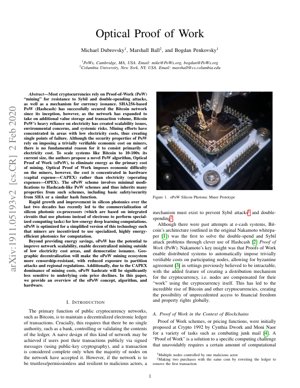
The paper references a prototype (Figure 1). A detailed description would involve a silicon photonic chip designed with waveguides, modulators, and detectors performing the specific computational steps of the oPoW algorithm. The experimental setup would compare the energy per hash (Joules/Hash) and hash rate (Hashes/second) of the oPoW prototype against a state-of-the-art SHA256 ASIC miner, demonstrating orders-of-magnitude improvement in energy efficiency, albeit potentially at a different absolute hashrate.
Chart Description (Implied): A bar chart comparing Energy per Hash (J/H) for a traditional ASIC miner (e.g., 100 J/TH) vs. an oPoW photonic miner prototype (e.g., 0.1 J/TH). A second line chart shows the projected geographic distribution of mining nodes, moving from a few concentrated peaks (traditional) to a more even, global dispersion (oPoW).
6. Analysis Framework Example Case
Case: Evaluating Network Security Under Economic Stress.
Traditional PoW (Bitcoin-like): Scenario: Coin price drops 70%. Mining revenue plummets. Miners with high electricity costs (OPEX) become unprofitable and shut down, causing hashrate to drop sharply (~50%). This reduces network security (cost to attack) proportionally, creating a potential vicious cycle.
oPoW Model: Scenario: Same 70% price drop. Mining revenue drops. However, the primary cost is hardware CAPEX (already sunk). The marginal cost to continue mining is very low (minor electricity for photonics). Rational miners continue operating to recoup hardware investment, leading to a much smaller drop in hashrate (~10-20%). Network security remains more robust during market downturns.
7. Future Applications & Development Roadmap
- New Blockchain Networks: Primary application is in the design of new, energy-sustainable Layer 1 blockchains.
- Hybrid PoW Systems: Potential integration as a secondary, energy-efficient mining algorithm alongside traditional PoW in existing chains.
- Hardware Evolution: Roadmap includes miniaturization of photonic miners, integration with general-purpose chips, and mass-production to drive down CAPEX.
- Beyond Cryptocurrency: The underlying photonic co-processor technology could be used for other verifiable delay functions (VDFs) or privacy-preserving computations.
- Regulatory Greenwashing Shield: oPoW could provide a clear technical pathway for PoW-based networks to address ESG (Environmental, Social, and Governance) concerns head-on.
8. References
- Dubrovsky, M., Ball, M., & Penkovsky, B. (2020). Optical Proof of Work. arXiv preprint arXiv:1911.05193v2.
- Nakamoto, S. (2008). Bitcoin: A Peer-to-Peer Electronic Cash System.
- Dwork, C., & Naor, M. (1992). Pricing via Processing or Combatting Junk Mail. Advances in Cryptology — CRYPTO’ 92.
- Back, A. (2002). Hashcash - A Denial of Service Counter-Measure.
- Shen, Y., et al. (2017). Deep learning with coherent nanophotonic circuits. Nature Photonics, 11(7), 441–446. (Example of photonic computing research)
- Cambridge Centre for Alternative Finance. (2023). Cambridge Bitcoin Electricity Consumption Index (CBECI). [External source for energy data].
9. Expert Analyst Commentary
Core Insight: The oPoW paper isn't just a hardware tweak; it's a strategic attempt to re-architect the fundamental economic incentives of Proof-of-Work. The authors correctly identify that PoW's existential crisis isn't the "work" itself, but the type of cost it externalizes. By shifting the burden from volatile, geopolitically-sensitive OPEX (electricity) to depreciating, globally-tradable CAPEX (hardware), they aim to create a more resilient and geographically distributed security base. This is a direct response to the damning critiques from institutions like the Cambridge Centre for Alternative Finance, which highlight Bitcoin's massive energy footprint.
Logical Flow & Comparison: The logic is compelling but faces a steep adoption cliff. It mirrors the evolution from CPUs to GPUs to ASICs in Bitcoin's history—a relentless pursuit of efficiency that inevitably centralizes around the best hardware. oPoW risks replaying this tape: early photonic ASIC manufacturers could become the new centralizing force. Contrast this with the post-merge Ethereum model, which abandoned physical cost entirely for cryptographic stake. While Proof-of-Stake (PoS) has its own centralization critiques around capital, it represents a different philosophical branch. oPoW is arguably the most elegant evolution of the original Nakamoto consensus, preserving its physical anchor while attempting to mitigate its worst externalities.
Strengths & Flaws: Its greatest strength is addressing the ESG critique without resorting to a total paradigm shift. The potential for stable hashrate is a profound, under-discussed advantage for long-term security planning. However, the flaws are significant. First, it's a "bet on a technology"—silicon photonics for mass-market, reliable computation is still nascent compared to mature digital CMOS. Second, it creates a new form of centralization risk around the photonic hardware supply chain, which may be as concentrated as the semiconductor industry today. Third, the security argument rests on the capital cost of hardware being a sufficient deterrent. If photonic chips become cheap to manufacture (like GPUs once were), the security model could weaken.
Actionable Insights: For investors and builders, watch this space closely but with skepticism. The first viable oPoW-based blockchain that gains traction will be a monumental proof-of-concept. Until then, treat it as a high-potential, high-risk R&D pathway. For existing PoW chains, the research provides a blueprint for a potential "hard fork" to a hybrid or fully optical system if regulatory pressure becomes existential. The key metric to track is not just J/Hash, but the time-to-amortization of the photonic hardware and the decentralization of its manufacturing. oPoW's success hinges as much on open, competitive hardware design as it does on the brilliance of its algorithm.